Before the Moyle family sold Lakewood Farm, architect Stephen Macdonald and his wife, Norma, rented a cottage on a farm across Highland Drive from Walker Lane. The farm was about to be sold and divided into lots. A group of local families met, saw the same thing Macdonald saw in the wooded stream, the lake and the open meadow, and took an option on 20 acres in 1955. That land is now the Cottonwood Club at 1780 Lakewood Drive. The houses that went up next to it were later recognized by the National Register of Historic Places.
Holladay's preservation has mostly worked that way ever since. The old places that survive tend to have a group of neighbors, a club or one owner behind them. The city's list of designated historic sites has seven entries, and two of them were added in the last 14 months. The whole set fits in a short loop. With guests in town over Thanksgiving, it makes a better afternoon than another lap of the mall.
Start at the lake that the farm left behind
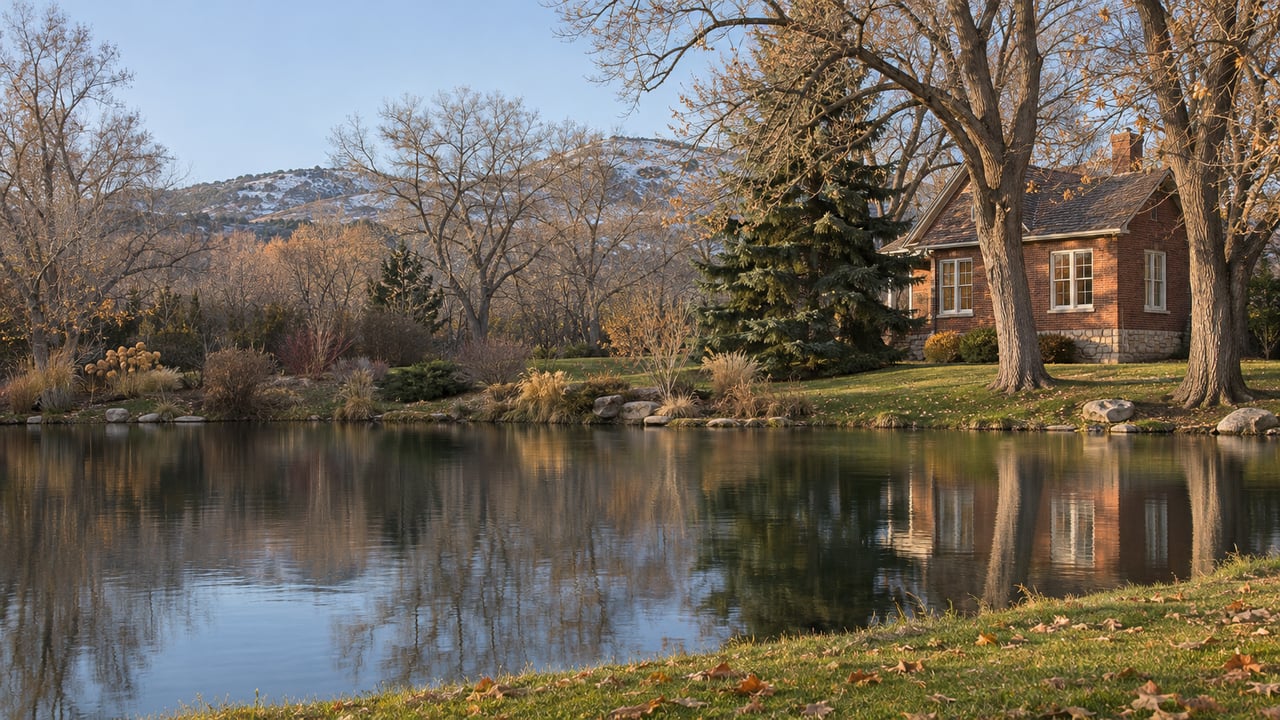
In 1906, James Henry Moyle and Alice Dinwoodey Moyle bought 99 acres of pasture that ran from Highland Drive west to what became the Van Winkle Expressway, and from Spring Lane south to 5600 South. They paid $6,500, most of it from the sale of Alice's share of her father's Dinwoodey Furniture Store. They called it Lakewood Farm. Over the next decades they dug out a swampy area and gathered its springs into a proper lake, and Alice and her sons built a bridge over it.
When the Moyle children sold the farm in the 1950s, buyer Manford Shaw planned to subdivide all 99 acres. Without the club, the 20 acres might have held about 50 more ranch houses. Instead, the founding families sold memberships, optioned the land in 1955 and built a pool and tennis courts in 1957. Macdonald designed the locker house and did the basic land planning. Norma Macdonald, a graduate of the Art Institute of Chicago, designed the club's leaf logo. In 1959 the club sold 300 memberships to pay for a real clubhouse. Macdonald's Japanese-inspired design had a swooping roof that seemed to float at the lake's edge, and it cost $85,000.
That clubhouse was torn down and replaced in 2013. The Moyles' lake is still there and still defines the club. In 2025 the Cottonwood Country Club was added to the city's self-guided preservation tour for the first time, according to the Holladay Journal.
The 1955 Parade of Homes, one street over
The houses on Lone Peak Drive and South Fairoaks Drive went up on former Moyle land when the farm was divided. In 2022, the National Register of Historic Places recognized the cluster as the 1955 Parade of Homes Lakewood Site Historic District. Many of the Parade houses have names, the way model homes did then. The city's Historic Holladay tour guide lists them by address:
- The Geraldine, 5483 Fairoaks Drive
- The Dude, 5473 Fairoaks Drive
- The Sunny Dale, 5465 Fairoaks Drive
- The Dover, 5476 Fairoaks Drive
- The Virginian Jr., 5490 Fairoaks Drive
- Bel Vista, 1590 E. Lone Peak Drive
- The Connecticut Yankee, 1623 E. Lone Peak Drive
- The Red Robin, 1635 E. Lone Peak Drive
- The Cosmopolitan, 1649 E. Lone Peak Drive
- Home #15, 1650 E. Lone Peak Drive
Macdonald was the center of a group that the Holladay Journal described in 2019 as a modernist circle. It included artist V. Douglas Snow, structural engineer Arthur Munse, interior designers Noal Betts and Blair Bowen, and landscape architect Richard Hatch. The paper reported that they gathered to talk about how modern art and architecture could change Utah. The same story described Macdonald's homes as built around small bedrooms, large shared rooms, atriums and walled gardens, sometimes with Japanese and Brazilian modernist touches.
The neighborhood's recent preservation story started on one of these streets. David Amott, then interim executive director of Preservation Utah, told the Holladay Journal that when he was invited to see the neighborhood, he watched a Macdonald home on Lone Peak Drive being demolished. Neighbors who were upset by the teardowns worked with Preservation Utah on the fall 2019 Salt Lake Modern Home Tour. "This was the genesis for our tour," he told the paper. Three years later the district had its National Register recognition.
These are lived-in homes. The city guide asks visitors not to disturb the owners, so the Parade of Homes is something to see from the sidewalk or from a slow car.
Seven houses on the city's list
Holladay's code names seven designated historic sites:
- The David Branson Brinton home, 1981 E. Murray-Holladay Road
- The Santa Anna Casto home, originally on Casto Lane and moved to City Hall Park in 2009
- The William J. Bowthorpe home, 4910 Holladay Boulevard
- The George Boyes home, 4766 Holladay Boulevard
- The David McDonald home, 4659 Highland Drive
- The Dinwoodey Home, 2052 E. Arbor Lane
- Casper Cottage, 2394 E. Murray-Holladay Road
The oldest stories on the list are on Holladay Boulevard. The George and Elizabeth Taylor Boyes House at 4766 Holladay Boulevard is a two-story adobe-brick house finished in 1884. It has lost its Victorian porch. The Bowthorpe home is farther south on the same boulevard, at 4910.
The two newest entries were both added within the last 14 months. The City Council added the David McDonald home at 4659 Highland Drive in October 2025. The Holladay Journal reported that owner John Branscomb sought the designation and planned to restore the house and open a jewelry boutique there. The paper also said David and Arabella McDonald built the house in 1890 and that it had been on the National Register since 1980. The city's tour guide gives 1894 as the year.
Casper Cottage joined the list in February 2026. It is a small cross-wing brick cottage built in 1898 and associated with Duncan Spears Casper's family. Casper came to Utah in 1855 with his wife and three children, settled in Holladay and bought seven acres in 1879, according to Holladay Arts' history of the cottage. The cottage is on the same road as the David Branson Brinton home at 1981 E. Murray-Holladay Road, so the two make one stop.
Two Brinton houses, one still standing
The name causes confusion. The Brinton home on the city's list is the David Branson Brinton home at 1981 E. Murray-Holladay Road. A different Brinton house stood at 4880 S. Highland Circle. Franklin and Alwilda Brinton built it in the late 1870s, and the city's tour guide records that it was demolished in 2024. In 2023 the Holladay Journal reported that Sequoia Development had bought the property and planned 11 townhomes. Residents had started a petition to save the house.
Only the Murray-Holladay Road house was on the city's list. Both were old, both carried a founding family's name, and both had neighbors who cared about them.
The loop, in driving order
The stops run from Lakewood Drive to 6200 South. In driving order:
- The Cottonwood Club, 1780 Lakewood Drive. Start where the Moyles' lake still sits.
- Lone Peak Drive and Fairoaks Drive. Pass the 1955 Parade of Homes houses, from Bel Vista at 1590 E. Lone Peak to The Virginian Jr. at 5490 Fairoaks.
- The David McDonald home, 4659 Highland Drive.
- Holladay Boulevard. See the Boyes home at 4766 and the Bowthorpe home at 4910.
- Murray-Holladay Road. See Casper Cottage at 2394 and the David Branson Brinton home at 1981.
- City Hall Park, 4580 S. 2300 East. The Santa Anna Casto house, built around 1870, was moved here from Casto Lane by way of Murray-Holladay Road. City Hall is the 1928 Holladay Elementary School building, designed by the firm Ashton and Evans. City Hall is currently closed for a seismic retrofit, as covered in our fall look at Holladay's civic calendar, so plan to see it from the outside.
- The Cottage at Knudsen's Corner, 2820 E. 6200 South. End at this 552-square-foot adobe cottage from 1900, next to the Cotton Bottom Inn. In a 1997 Salt Lake Tribune column, journalist Jack Goodman reported the Knudsen family's account that Rudolph Knudsen built it as a wedding present for his son Frederick and Frederick's wife, Mary Cahoon. The family called it the "Honeymoon Cottage," as Holladay Arts' history of the cottage retells it.
The Dinwoodey Home at 2052 E. Arbor Lane is the one stop off the main loop. Its name leads back to the start of the drive: the Dinwoodey Furniture Store money paid for the farm that became the Cottonwood Club.
If you own one of Holladay's older homes, from a Lone Peak Drive mid-century to a brick cottage off Murray-Holladay Road, its history is part of what a buyer is paying for. When you're ready to talk about how to tell that story, or just want to know where your home stands, Sue Ann Wilkinson would love to sit down with you. Request a Complimentary Market Consultation, and bring along anything you know about who built your house.